Curious if LED or ceramic metal halide lighting is right for your home?
Microsun’s Metal Halide (MH) and Ceramic Metal Halide (CMH) based reading lamps have earned a well-deserved reputation for excellence over the past three decades. When introduced, they set new standards in contrast, color, efficiency and output for their size. However new technologies and upcoming regulatory controls are shifting away from MH and toward LED. Microsun’s new LED lighting technology is not just an alternative to MH, it’s a generational leap forward.
Understanding 4000K — The Gold Standard for True-White Light
Color temperature, measured in Kelvin (K), describes the appearance of white light on a warm-to-cool spectrum. It’s one of the most misunderstood specifications in lighting, and one of the most consequential.
Microsun LED bulbs are engineered at 4000K: a bright, crisp, neutral white. Not the amber haze of incandescent, and not the clinical blue-white that makes you feel like you’re being interrogated. At 4000K, colors render honestly, details appear sharp, and environments feel alive without feeling harsh. Our new TruFull™ spectrum light sources deliver both brightness for visibility and fidelity for detail, resulting in sharper contrast, reduced glare, and less eye fatigue — especially important for aging eyes that naturally lose light sensitivity.
Redefining “Daylight”
In recent years, the lighting industry has labeled 5000K – 6500K bulbs as “daylight.” It’s a shorthand that has stuck, but it’s misleading, and worth rethinking.
True midday sun — at its harshest, directly overhead — measures around 5000–5500K. That’s a very specific moment: noon on a cloudless day. It’s high contrast, high UV, and most people wouldn’t call it particularly pleasant or inviting.
Ask anyone what their favorite quality of natural light looks like, and they’ll describe something far warmer. Golden hour — that window of an hour or two after sunrise and before sunset — runs between 2000K and 4000K. It’s the light that makes landscapes glow, makes food look extraordinary, and makes people look their best. Photographers call it magic light for a reason.
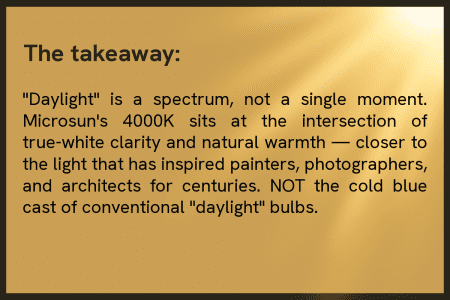
At 4000K, Microsun’s LED’s capture the upper range of that golden quality. It’s the kind of light your eyes are designed to thrive under — bright enough to energize, warm enough to flatter. Not the sterile blue-white of a science lab at noon.
LED vs. Ceramic Metal Halide — A Practical Comparison
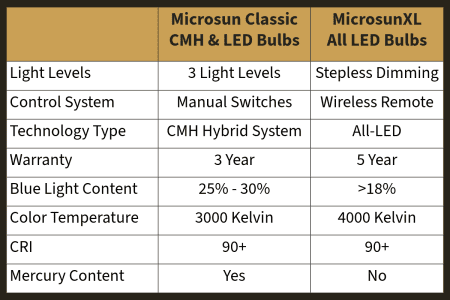
CMH bulbs have genuine strengths. They are not a bad technology — they are simply an aging one, being surpassed on nearly every practical dimension by LED.
The Hidden Costs of CMH Technology
Microsun’s ceramic metal halide bulbs have long been celebrated for their exceptional color rendering and natural light quality — and if you have them, they’re still doing a fantastic job. However, as technology continues to evolve, our new MicrosunXL LED lighting system represents the next exciting chapter: delivering the same beautiful, full-spectrum light with greater energy efficiency and longer lifespans. It’s also worth knowing that the U.S. is phasing out the production of CMH bulbs by 2027, making now a great time to explore the LED options available. Whether you’re ready to make the switch today or simply planning ahead, Microsun LEDs offer a seamless, future-proof upgrade — same great light, smarter technology.
Warm-up and restart delays. Every time a CMH lamp is switched on from cold, it needs several minutes to reach full brightness. If the power is interrupted — even briefly — the lamp must cool completely before it can restart, a process that can take 10 to 20 minutes. It is a functional limitation. Microsun LED lamps are simply on, instantly, every time.
Heat and UV degradation. CMH bulbs operate at high internal temperatures and emit measurable ultraviolet light. Over time, this UV output is not benign: it can fade fabrics, discolor plastics, and degrade lampshades — particularly those made from paper, natural fibers, or lighter-colored materials. LED technology does not generate UV and operates at far lower surface temperatures.
Mercury disposal. CMH bulbs contain trace amounts of mercury, a regulated hazardous substance. This adds complexity and cost to disposal, and creates environmental liability if lamps are broken during handling. Microsun LED bulbs contain no mercury, no regulated hazardous materials — and no associated disposal burden.
Why Microsun LED is Built for the Future
Not all LED products are equal. The rapid expansion of the LED market has produced a wide range of quality levels — from precision-engineered commercial products to budget alternatives that sacrifice color accuracy, lifespan, and consistency for a lower price point.
Microsun LED bulbs are engineered specifically around the 4000K standard because of the way the color temperature illuminates in real environments. In offices and workspaces, the neutral-white quality supports focus and reduces eye strain compared to the aggressively blue 6000K alternatives. In your home, 4000K finds the balance between the energy of bright light and the comfort of warmth.
Combined with Microsun’s commitment to long-rated lifespan, genuine color rendering performance, and mercury-free construction, the result is a product that doesn’t just meet the moment — it was designed for decades ahead.

(937) 552-2424
Monday-Friday: 8am–5pm
Saturday & Sunday: Closed